ShellForm: the carbon cost of seismic resilience in form-found concrete shells
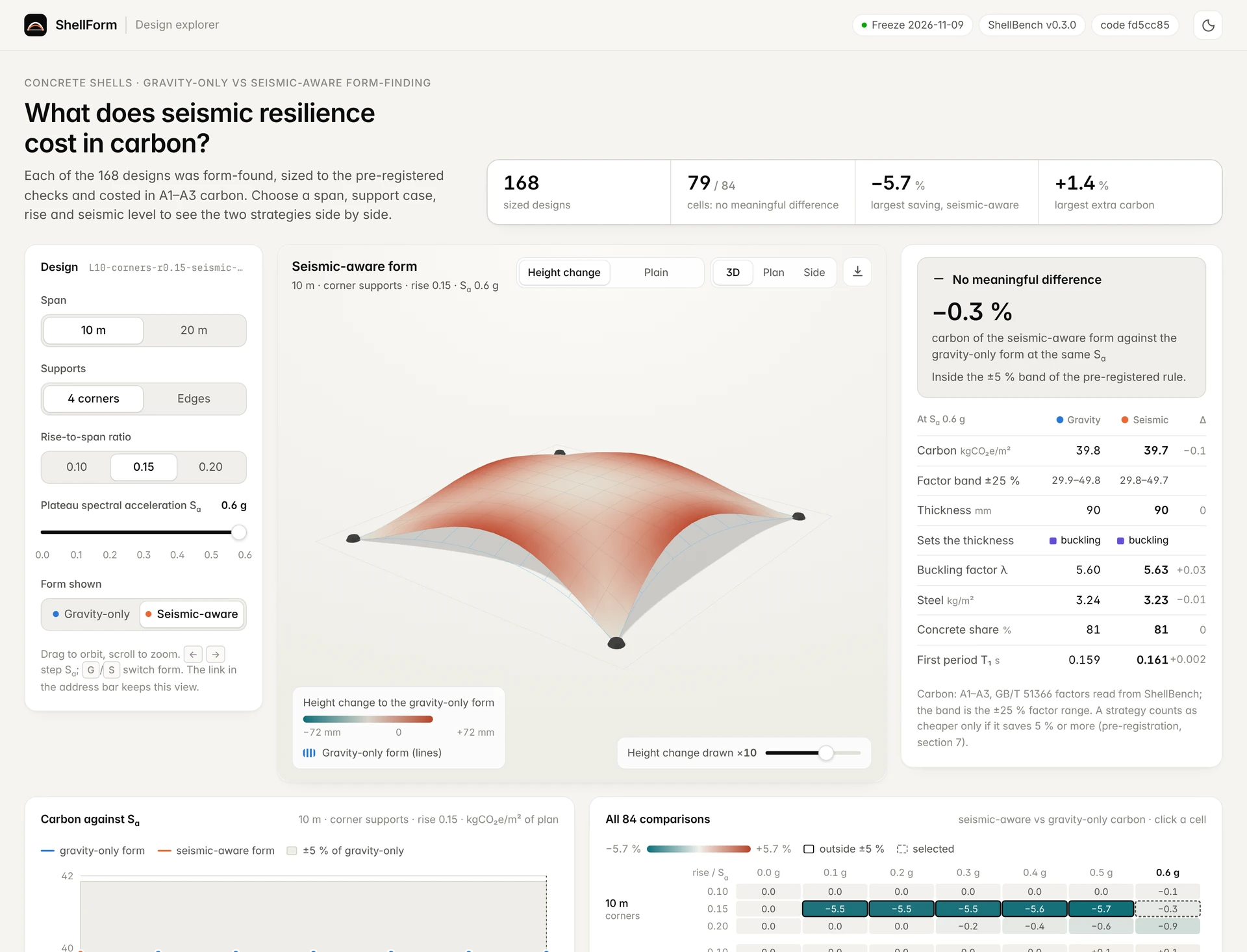
How much embodied carbon does earthquake resistance cost in a form-found concrete shell, and does form-finding that includes seismic loads deliver it more cheaply than thickening a gravity-only shape? 168 sized designs and an interactive explorer.
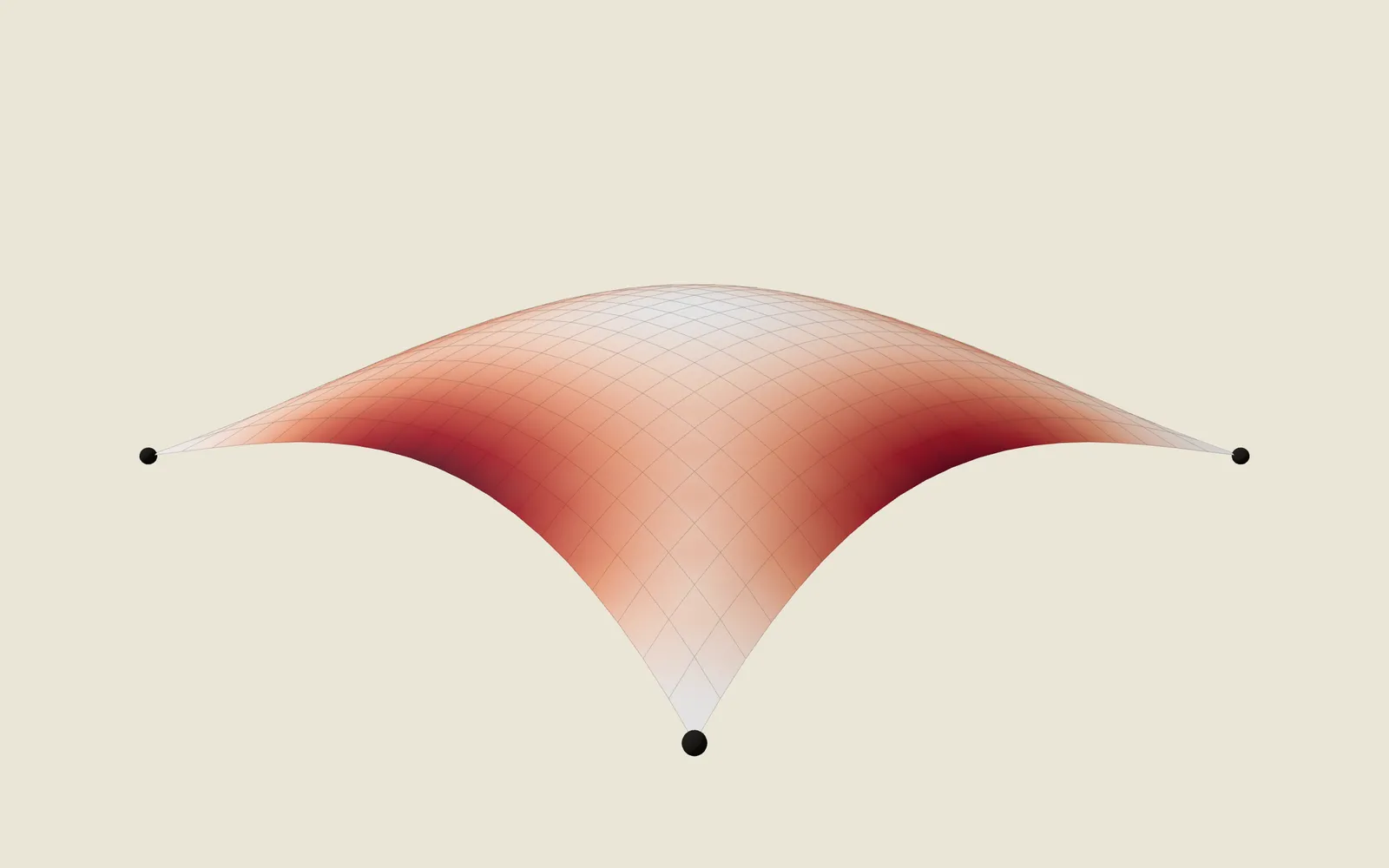 Drag to orbit · scroll or pinch to zoom
Key numbers
- Sized designs
- 168shells
- 2 spans × 2 support cases × 3 rises × 2 strategies × 7 Sa levels
- Decision rule
- 5%
- Pre-registered: a strategy counts as cheaper only if it saves at least this much
- Seismic demand range
- 0–0.6g
- Code-independent Sa range; GB 50011 and Eurocode 8 sites marked
Question
How much embodied carbon does seismic resilience cost in a form-found concrete shell, and does form-finding that includes seismic loads deliver it more cheaply than thickening a gravity-only shape?
ShellForm extends the seismic form-finding of Michiels and Adriaenssens (2017, 2018) by sizing each form to pass code checks and counting its A1–A3 embodied carbon.
Approach
- Design space. 2 spans × 2 support cases × 3 rise ratios × 2 strategies (gravity-only, seismic-aware) × 7 spectral acceleration levels = 168 sized designs, across a code-independent seismic demand range of 0–0.6 g, with Chinese (GB 50011) and Eurocode 8 sites marked.
- Sizing. Each form is thickened in 5 mm steps until it passes its checks, including linear buckling and a 50 mm minimum thickness, then given its reinforcement.
- Carbon. A1–A3, reported under two factor sets (GB/T 51366 and ICE).
- Decision rule. Pre-registered: a strategy counts as cheaper only if it saves 5 % or more.
- Record. Code frozen at tag
freeze-2026-11-09on ShellBench v0.3.0; every number traces to a file inresults/. ShellForm never copies a ShellBench value.
Validation
ShellForm is built on ShellBench’s validated, tagged modules, whose shell analysis reproduces the Scordelis–Lo roof and pinched hemisphere benchmarks within 0.4 %. The new seismic form-finding code has its own validation tests; the suite stood at 101 passing tests on 10 November 2026.
Findings in brief
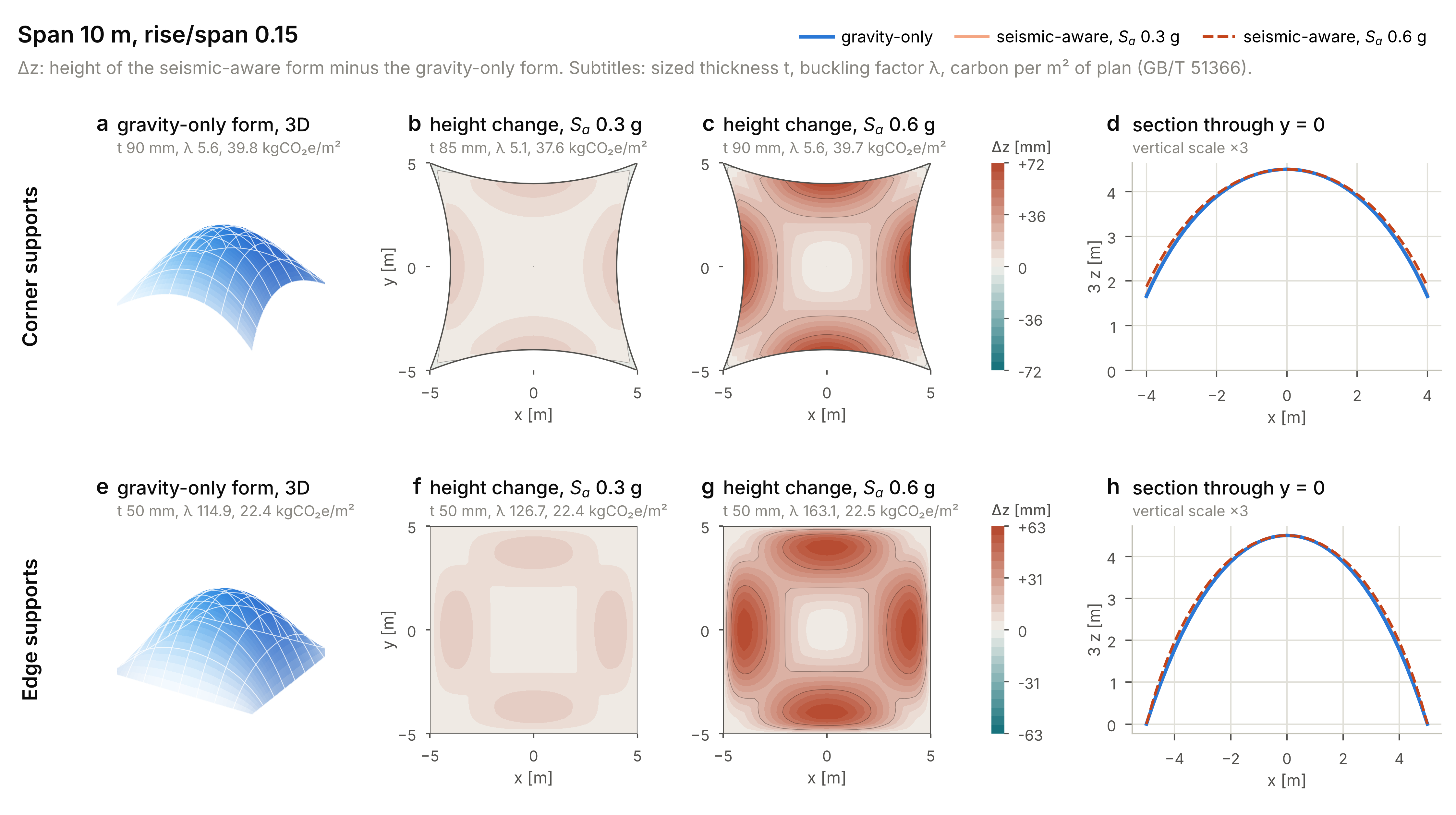
Across the design space, adding seismic load to form-finding changes the shape of the shell much more than the amount of material in it. The reason lies in the sizing: thickness and steel are governed by checks that do not respond to the seismic demand studied. The full comparison, the mechanism and the robustness checks are in the manuscript in preparation.
What this does not show
- Shells are studied as isolated roofs on idealised supports, not as part of a building.
- Seismic demand is applied through a code-independent spectral acceleration range; site-specific hazard is not modelled.
- Carbon is cradle-to-gate (A1–A3); formwork and construction are excluded.
- The manuscript is in preparation; the findings follow a pre-registered rule but are not yet peer reviewed.
Evidence
- Benchmark
- Shell analysis inherited from ShellBench v0.3.0 (Scordelis–Lo roof, pinched hemisphere); new validation tests for the seismic form-finding code
- Metric
- Computed / reference displacement
- Result
- 0.9984 and 0.9965
- Code
- github.com/syednafizreja/ShellForm
- Release
- v0.1.0
- DOI
- 10.5281/zenodo.24084110
- Tests
- 101 passed (pytest, 10 Nov 2026)
- Licence
- MIT