
Parametric carbon optimisation of an aviation-terminal canopy
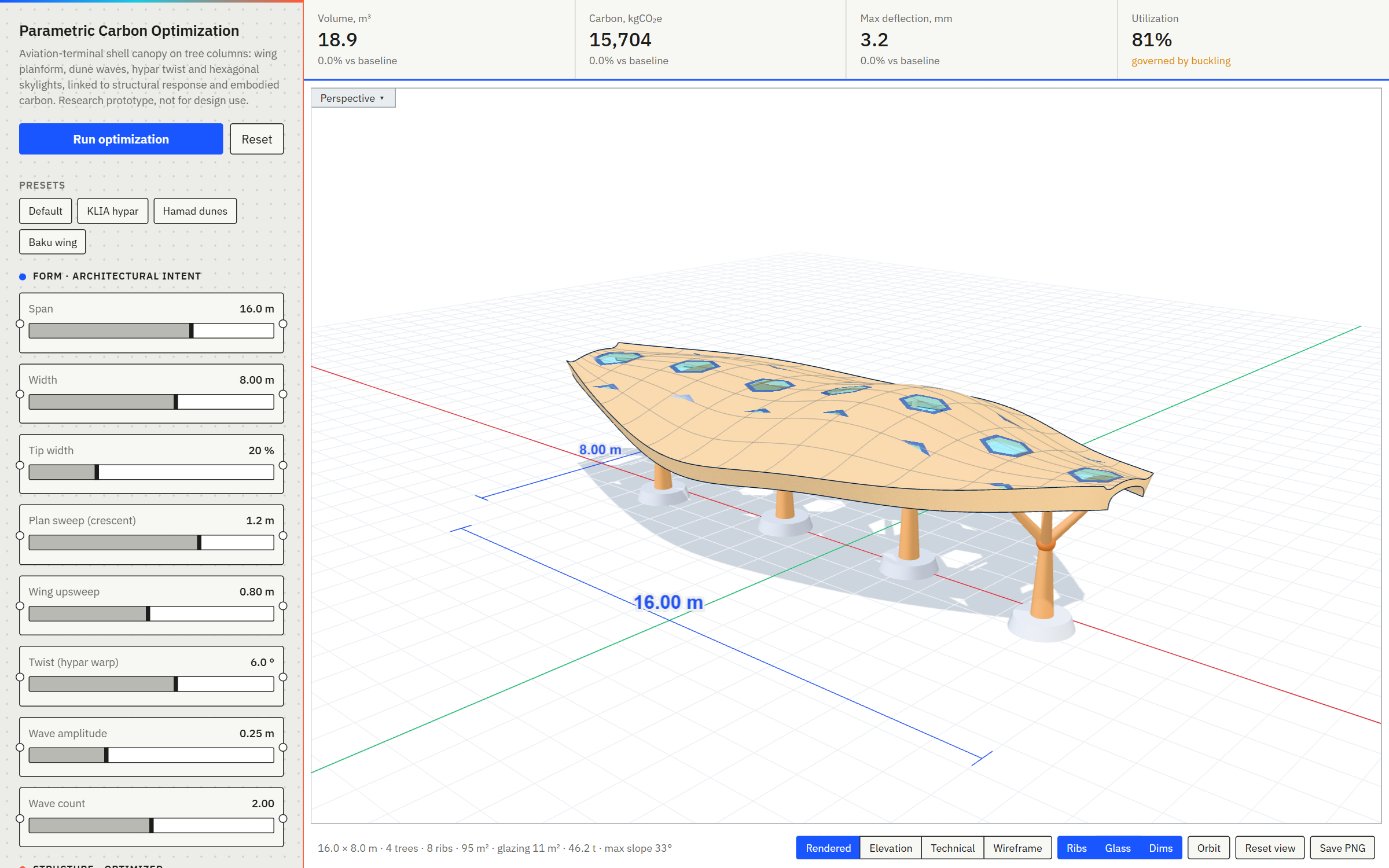
An interactive research prototype that links canopy geometry to structural response, material volume and embodied carbon for a thin shell canopy on tree columns, so the trade-off can be explored live in the browser.
Key numbers
- Parameters
- 16
- In three groups: form, structure and details
- Baseline canopy
- 16.0 × 8.0m
- Shell on four tree columns
- Live readouts
- 4
- Material volume, embodied carbon, deflection and utilisation
Question
When an architect changes the shape of a large shell canopy, what happens to its structure and its carbon, and can a designer see that trade-off while still sketching?
Approach
The tool links geometry → structural response → material volume → embodied carbon for a thin shell canopy in the language of contemporary airport terminals: a tapered wing planform on conical tree columns, tapered underside ribs, thickened edge beams and hexagonal skylights.
- Sixteen parameters in three groups. Form (span, width, tip width, plan sweep, wing upsweep, twist, wave amplitude and count) is architectural intent. Structure (rise, camber, crown exponent, thickness, tree supports, rib spacing) is what the optimiser varies. Details set skylight openness and branch spread.
- Volume, carbon, deflection and utilisation update in real time.
- Run optimisation moves the design toward a lower-carbon solution for the chosen span; presets morph the form between reference shapes.
- The viewport borrows conventions from Rhino (display modes, isocurves, axes, dimensions) and Grasshopper (sliders, solver-history plot).
Validation
None yet. Structural quantities are screening-level estimates that rank design alternatives; they have not been checked against finite-element analysis or code verification. The ShellBench and ShellForm projects were started to do that checking properly.
Results
A working, public prototype that a designer can open in a browser and use without installing anything. As the sliders move it updates material volume, embodied carbon, deflection and utilisation, and names the check that governs. These are screening estimates, not design values.
What this does not show
- The structural model is simplified; it is not a substitute for finite-element analysis or code checks.
- Carbon uses generic factors and excludes construction and end of life.
- The optimiser shows a direction of improvement, not a verified optimum.