Climate-driven moisture damage in nano-modified warm mix asphalt
A small, transparent scenario model that propagates a laboratory moisture-durability indicator, the tensile strength ratio, through time under monthly temperature and rain, and writes outputs that a BIM or asset record can store.
Key numbers
- Climate ensemble
- 2,000realisations
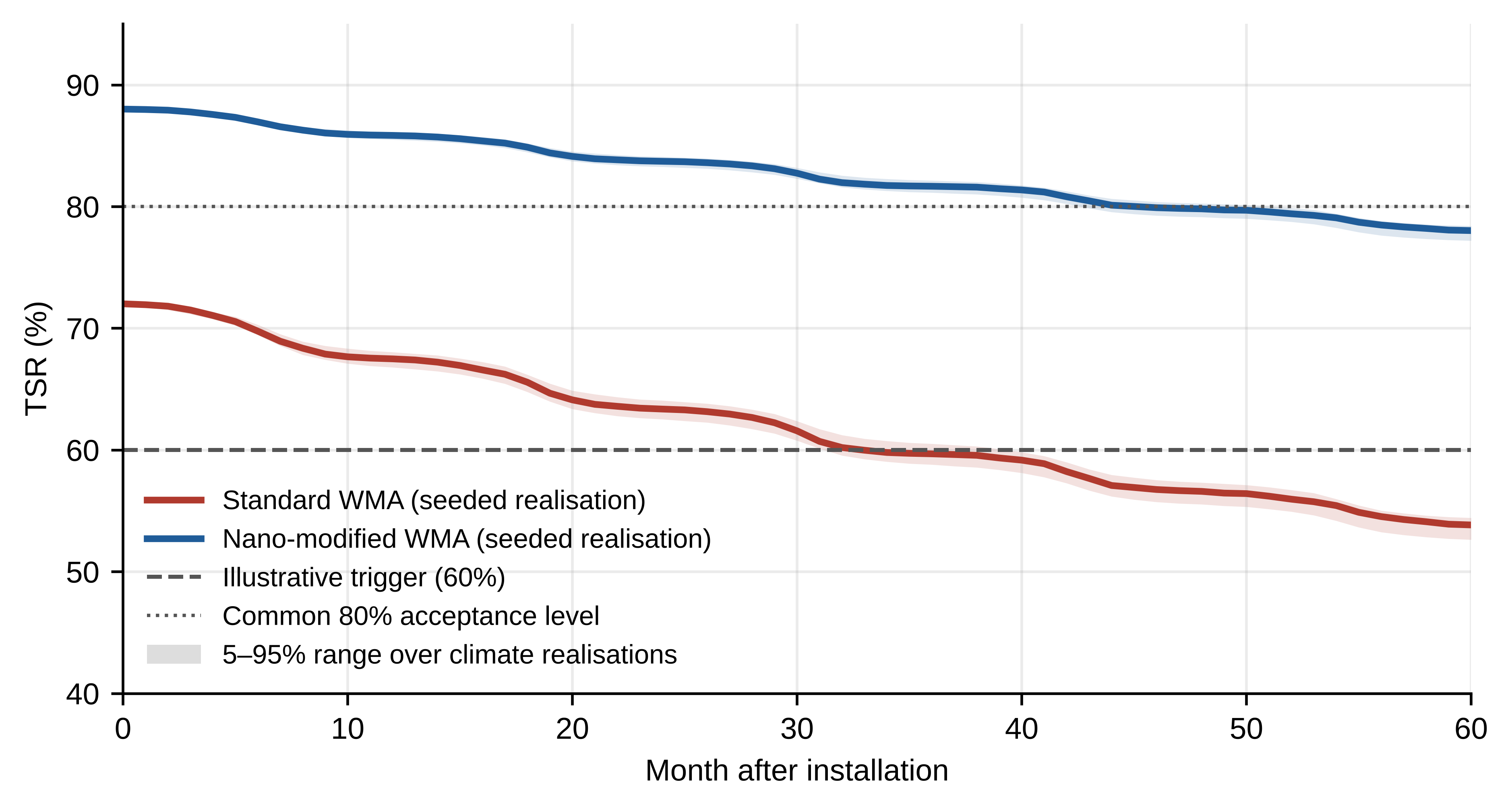
- Months to 60/70/80 % TSR reported as median and 5–95 % range
- Primary run
- 60months
- Seeded; reproduced exactly on a newer Python stack
Question
Laboratory moisture tests give one number at one moment. How could that number be carried forward in time, under a real climate, into something an asset manager can store and act on?
Approach
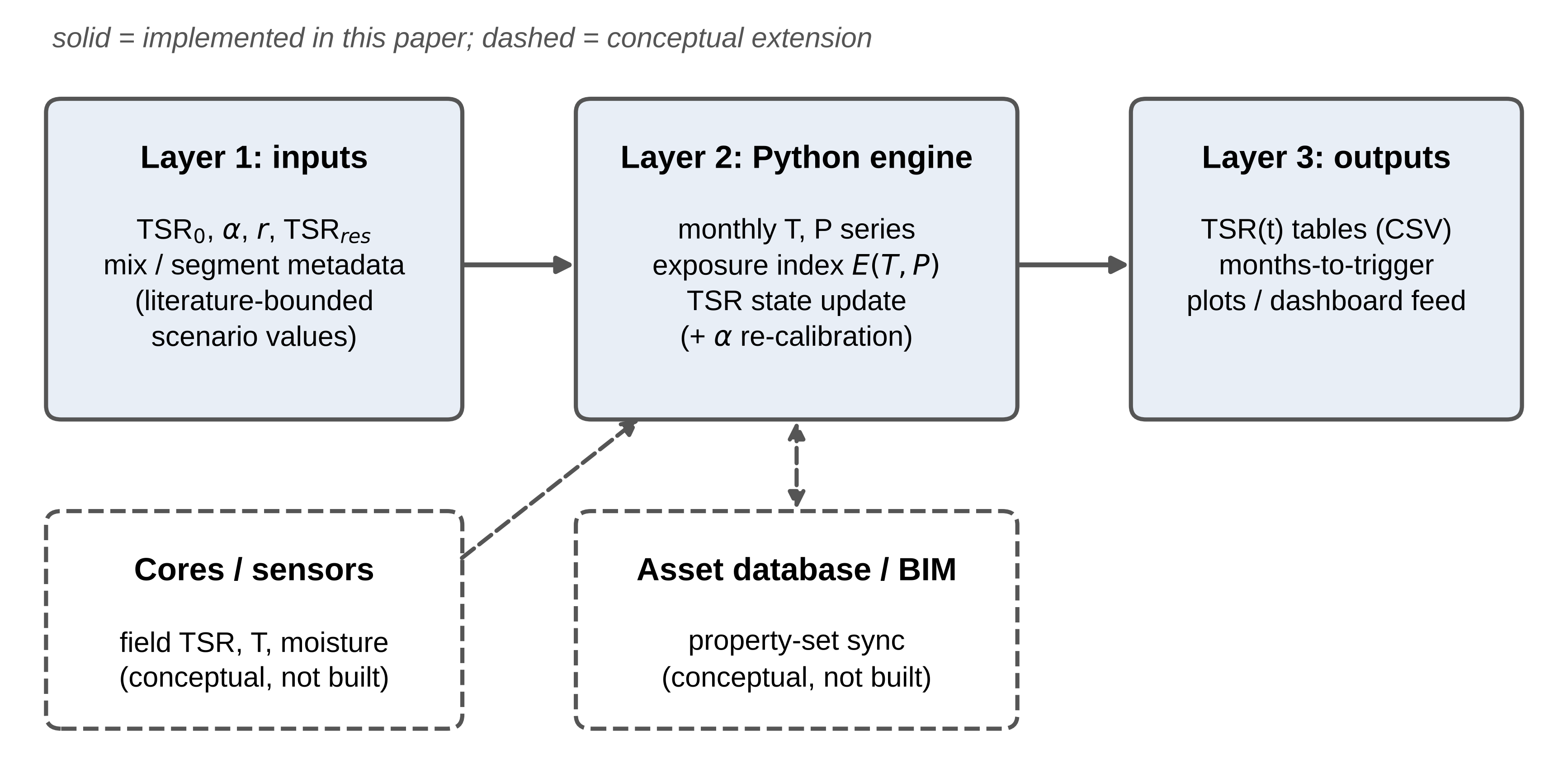
Each month gets a dimensionless exposure index, E = W(P) · Q10^((T − T_ref)/10), where W(P) is a saturating wetness function equal to 1 at the reference precipitation. The tensile strength ratio (TSR) relaxes toward a residual value, dTSR/dt = −α · E · (TSR − TSR_res), solved exactly month by month. A nano-modified mixture is represented by a higher initial TSR and a lower decay coefficient.
The model writes tables and figures that an asset database or BIM record could store, and includes a least-squares routine to re-calibrate the decay coefficient from measured core TSR values.
Validation
This is an empirical scenario model, not a validated predictor. What is checked is the engine: a built-in self-test, exact month-by-month solution, and full reproducibility (a re-run on a newer Python, NumPy, pandas and Matplotlib reproduced every reported value).
Results
Months to the 60, 70 and 80 % TSR thresholds are reported as a median and 5–95 % range over 2,000 climate realisations, with one-at-a-time sensitivity of every assumption.
What this does not show
- All material parameters are scenario inputs, and the climate series is synthetic around published monthly normals.
- Outputs are not service-life predictions.
- In the terms of Kritzinger et al. (2018) this is a digital model: no data flow to or from a physical pavement is automated.
Evidence
- Code
- github.com/syednafizreja/pavement-digital-twin
- Tests
- Built-in self-test (--selftest)
- Licence
- MIT