PaveCarbon: from laboratory durability to annualised pavement carbon
An open finite-element and life-cycle framework that carries a laboratory durability gain of nano-silica warm mix asphalt through a pavement structure to service life and annualised A1–A3 carbon, so the carbon claim becomes auditable.
Key numbers
- Temperature states
- 12per year
- Monthly asphalt moduli (Witczak) in the axisymmetric model
- Monte Carlo samples
- 1,500runs
- Uncertainty in the carbon comparison
- Mesh check
- 5,120elements
- Doubled mesh; tensile strain changes by less than 0.01 %
Question
Nano-modified warm mix asphalt is usually defended on two separate grounds: lower plant emissions and better laboratory durability. The two claims are seldom connected. A durability gain measured on specimens is rarely carried through a pavement structure, so its carbon value stays an assumption. What is that gain worth in carbon once it is?
Approach
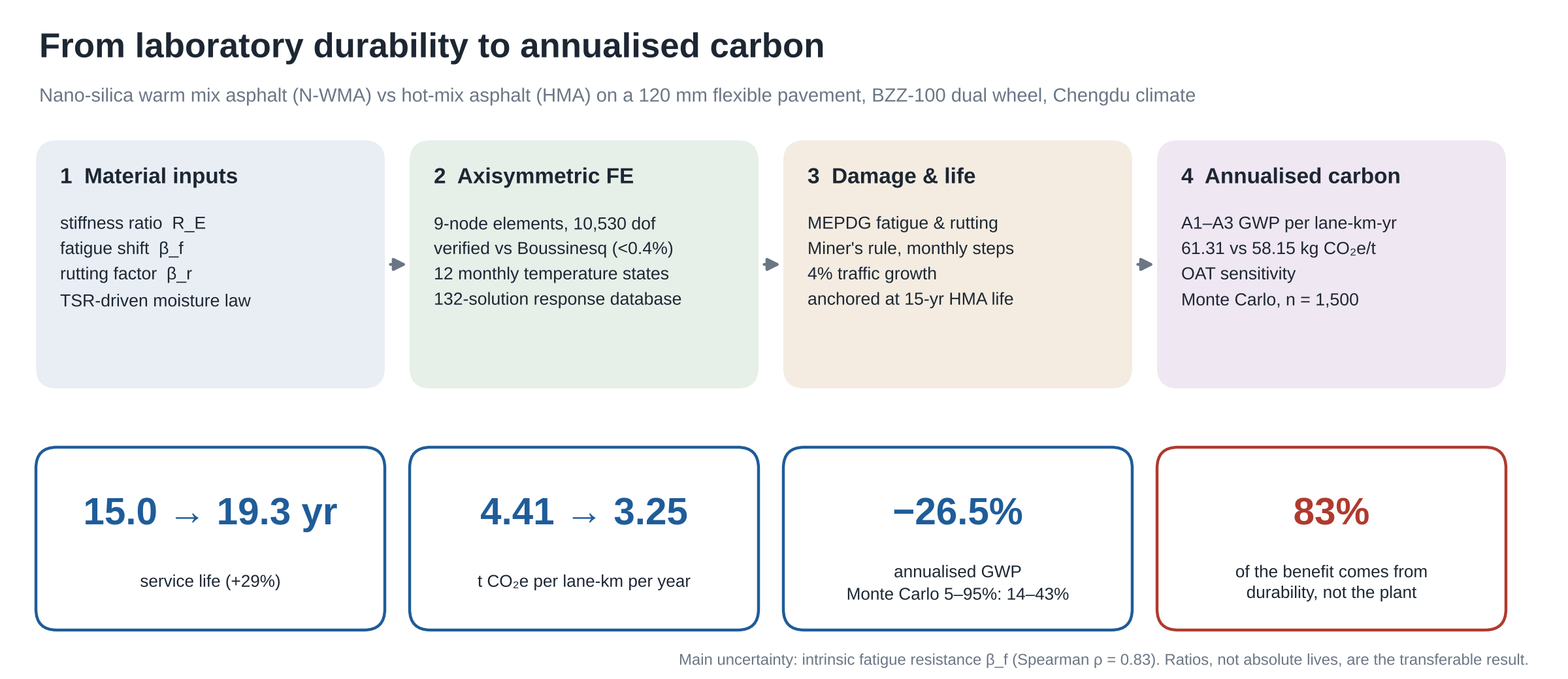
One chain, coded end to end:
- Material inputs: stiffness, fatigue and rutting coefficients, tensile strength ratio, plant temperature and GWP factors.
- Axisymmetric finite elements (Q9): dual-wheel standard axle, Witczak moduli, 12 monthly temperature states.
- Mechanistic-empirical damage: MEPDG fatigue and rutting, Miner’s rule, monthly traffic with growth.
- Annualised A1–A3 carbon per lane-km and year, with one-at-a-time sensitivity and a Monte Carlo run (n = 1,500).
Every number, table and figure in the paper is regenerated by one command.
Validation
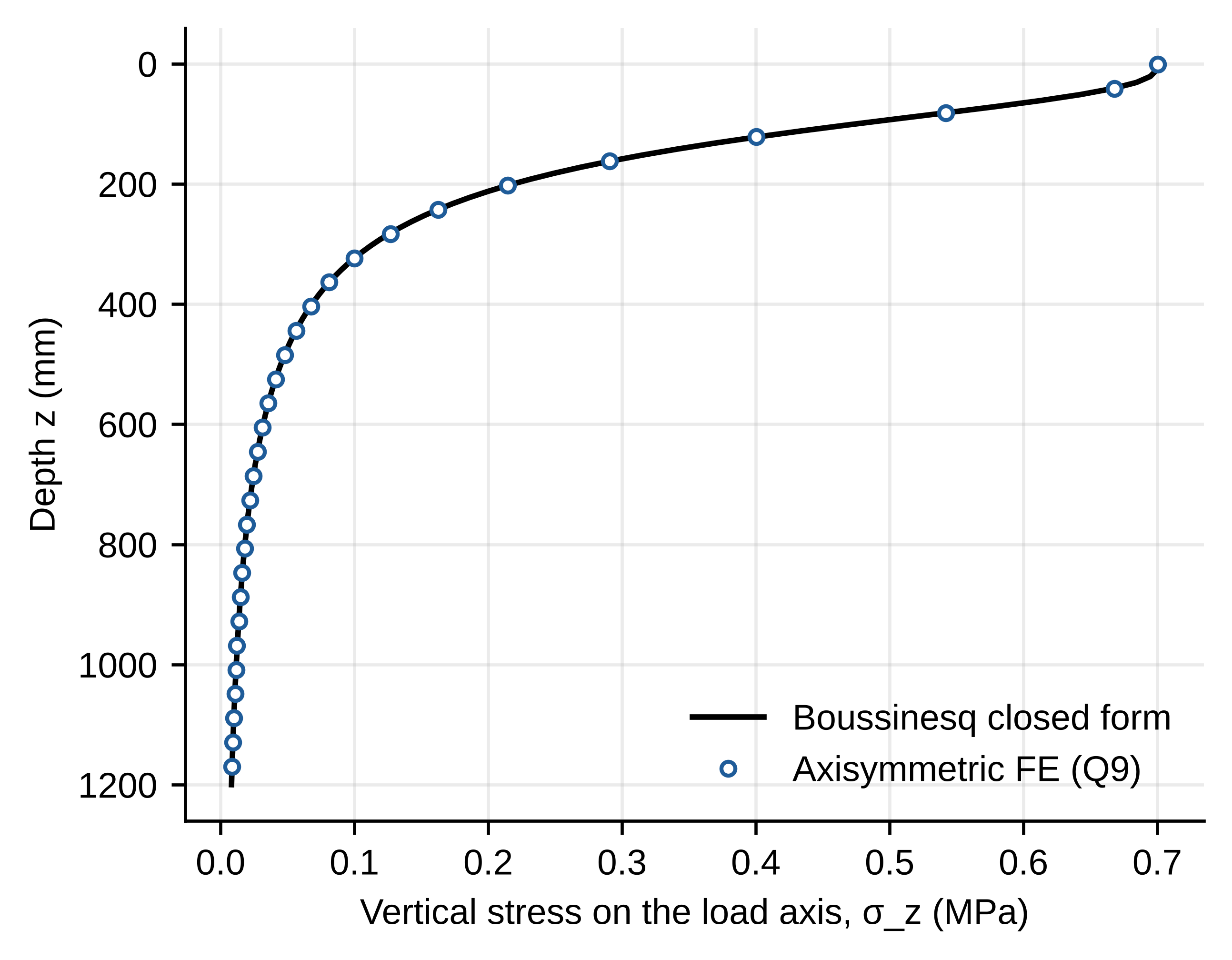
- Axis stress against Boussinesq for z = 50–400 mm: within 0.3 % (base mesh) and 0.4 % (doubled mesh).
- Surface deflection against Boussinesq: −1.5 % (4 × 6 m domain), −0.8 % (8 × 12 m).
- Mesh doubled to 5,120 elements: tensile strain changes by less than 0.01 %.
- Total applied load equals p·πa² to machine precision.
These checks run automatically on every push.
Findings in brief
In this framework nano-silica warm mix has lower annualised A1–A3 carbon than the hot-mix reference. Most of the benefit comes from longer service life and the rest from the lower plant temperature. Most of the uncertainty traces to one input, intrinsic fatigue resistance, and the reduction stays positive across the Monte Carlo range. Exact figures are in the manuscript in preparation.
What this does not show
- Service life is calibrated so that the hot-mix reference reaches exactly 15.0 years; the comparison is relative, not an absolute life prediction.
- Material inputs come from the literature and laboratory data, not from a monitored road.
- The scope is cradle-to-gate carbon of the asphalt layers, annualised over service life.
Evidence
- Benchmark
- Boussinesq closed-form solution; mesh doubling; total applied load
- Metric
- Axis stress error, z = 50–400 mm
- Result
- within 0.3 % (base mesh), 0.4 % (2× mesh)
- Code
- github.com/syednafizreja/nano-wma-pavement-carbon
- Release
- v1.0
- Tests
- 11 automated tests, including the headline numbers
- Licence
- MIT